

Trigeminal and Occipital Neuralgia: How To Tell the Difference
Exploring the Unique Causes of Headaches in Denver and How Chiropractic Care Provides Relief
Trigeminal neuralgia and occipital neuralgia are both uncommon but severe headache disorders that can often be treated with chiropractic care.
- Trigeminal neuralgia (TN) is when a compressed trigeminal nerve sends severe pain through your jaw or the side of your face. Touching your cheek, brushing your teeth, and even smiling can trigger TN. Some confuse TN with cluster or migraine headaches , but migraines and cluster headaches do not share the same triggers or treatments.
- Occipital neuralgia (ON) is when a compressed nerve in the occipital region sends severe pain up the back of your head and neck. Most ON cases occur due to the irritation of the greater occipital nerve, which originates from the 2nd cervical nerve in the back of your upper spine. However, 10% of cases are due to lesser occipital nerve compression.
Neuralgias are a relatively recent classification , but more and more people are discovering they have these serious nervous system conditions. They’re often diagnosed as “idiopathic,” meaning there’s no direct cause (such as trauma from a car accident or fall).
Even though TN and ON are rare, if you have either, you will want more than anything to get effective treatment.
Below, we’ll discuss detailed differences and similarities between trigeminal and occipital neuralgia. If you’re looking for a non-medical, non-surgical treatment that addresses the root cause of these chronic pain conditions, consider upper cervical chiropractic care .
The main difference between occipital neuralgia and trigeminal neuralgia is the nerve causing your pain. ON is caused by the inflammation or compression of the occipital nerve, while TN is caused by the inflammation or compression of the trigeminal nerve (the largest cranial nerve).
These nerve clusters are in different places around your head and upper spine. (See images below.)
More differences between ON and TN include the root causes, symptoms, and treatment options. However, all of these aspects have similarities and differences:
Occipital neuralgia is caused by inflammation or irritation of the occipital nerves, usually due to the greater occipital nerve specifically. TN is caused by inflammation or irritation of the trigeminal nerves. Although both sets of nerves are situated near your upper spine, trigeminal and occipital nerves are different.
Secondary Headaches
Secondary headaches are caused by an underlying medical condition instead of just an abnormality in your blood vessels.
These are less common, but still important to understand. Since it is important to treat the root cause of your headache — not just mask the symptoms — it can be helpful to see all the possible secondary causes laid out for you.
Here are the twelve common types of headaches (secondary) you need to understand :
Occipital neuralgia typically affects the back of the head and neck, while trigeminal neuralgia often affects one side of the face. TN has been described as the most severe pain one can experience, but ON can also present as severe.
Chiropractic care , acupuncture , botox injections , nerve block injections, and a neurectomy can reduce symptoms in both occipital and trigeminal neuralgia. Anti-inflammatories, antidepressants like amitriptyline, and anticonvulsants are common medications for ON, while only anticonvulsants are common for TN. Separate surgeries are employed for ON versus TN, as are different self-care strategies.
Henry Gray (1825–1861). Anatomy of the Human Body. 1918.
Trigeminal Neuralgia Symptoms
- Stabbing pain, typically on one side of the head (though both sides are occasionally impacted)
- Short bursts of severe pain ( usually lasting seconds , occasionally minutes)
- Numbness, burning, or tingling in the cheek or jaw
- Pain triggered by touching the cheek, speaking, or even a strong breeze
Occipital Neuralgia Symptoms
- Brief, paroxysmal pain in the back of the head and neck (could spread to the top of the head )
- Long-lasting, dull headache pain
- Sensitivity to light
- Sensitivity to touch
Treatment Options for Trigeminal and Occipital Neuralgia
Although there are different treatment interventions for trigeminal neuralgia versus occipital neuralgia, below are the common treatment options that may address both:
- Chiropractic care — A qualified chiropractor aligns your spine, which may reverse nerve compression. A misaligned upper spine is a likely cause of your trigeminal or occipital area getting compressed or irritated. Blood vessel (vascular) inflammation may also be triggering occipital or trigeminal pain, but a misaligned upper spine may also be the reason your blood vessels are inflamed. Talk to a chiropractor who specializes in orthospinology about your trigeminal or occipital pain.
- Acupuncture — It sounds too good to be true, but scientific studies have shown acupuncture is an effective treatment for both TN symptoms and ON symptoms. This is a better option than medication or surgery, but chiropractic care is the only direct treatment for TN and ON root causes.
- Botox injection — Botulinum toxin A (Botox) has been shown to manage both ON symptoms and TN symptoms. This is not a natural solution, however. Instead of addressing the root cause, botox injections dull the pain attacks without fixing the origin of your medical condition. Botulinum toxin is one of the most potent neurotoxins known to man — it literally just kills the nerves causing your pain.
- Anticonvulsant medication — Although different medications are prescribed for TN and ON, anticonvulsants (anti-seizure meds) such as gabapentin may be prescribed to treat both neuralgias. Carbamazepine is the conventional first-line treatment for TN, despite its side effects and danger to individuals of Asian descent.
- Neurectomy — The name of this last-resort surgery literally means “to sever the nerve.” In extreme cases, some doctors may refer you to a neurosurgery expert who can create lesions in the nerve fibers to halt pain signals. Side effects of neurectomies vary but may include dizziness or tingling sensations around the affected area.
- Peripheral nerve stimulation — This technique is where a neurosurgeon places electrodes along the peripheral nerves to control pain. This treatment aids in placing trigeminal or occipital nerve blocks.
- Nerve block — Both TN and ON can be treated with nerve blocks. Although this does not address the root cause of neuralgia, pain can be dulled with the use of local anesthetic such as lidocaine and a steroid. A block only provides temporary pain relief.
- Avoiding triggers — Touching the skin over your occipital or trigeminal nerves can trigger severe headache pain. Avoiding triggers like touching those parts of your face, head, or neck can naturally prevent the neuralgia pain from flaring up in the first place.
How Upper Cervical Chiropractic Can Help
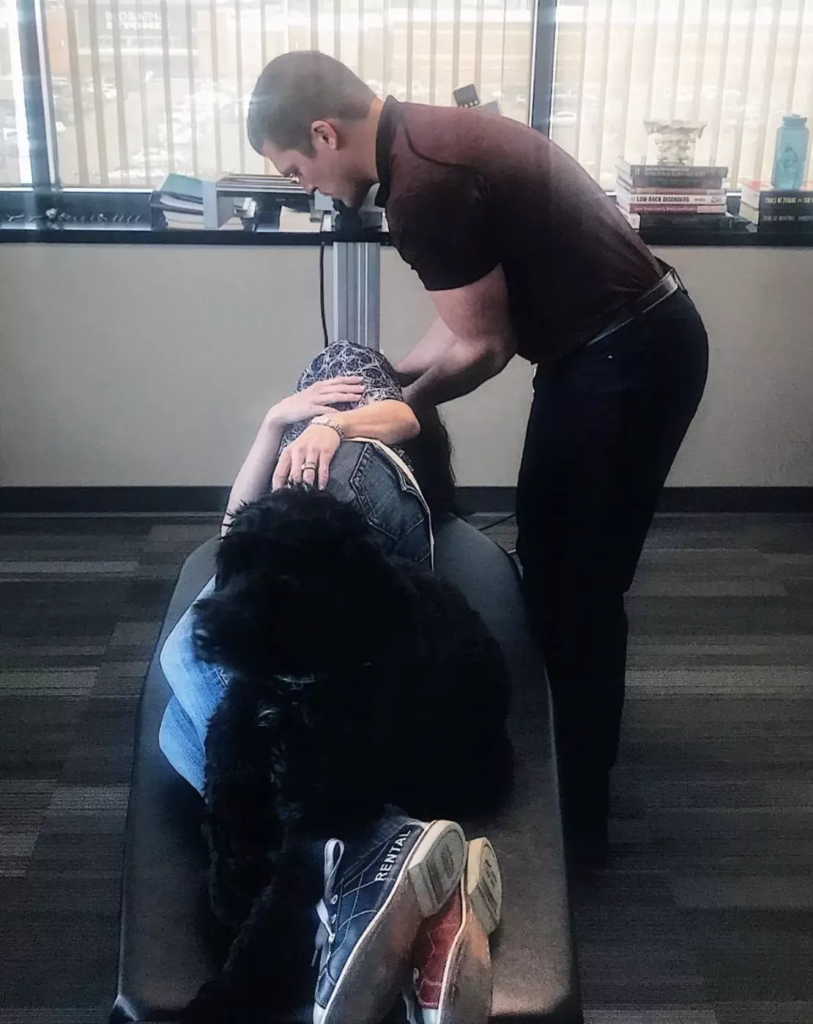
Upper cervical chiropractic care focuses on the top two vertebrae of your spinal cord: the atlas (C1) and the axis (C2). These top two vertebrae may be responsible for compressing or irritating your trigeminal or occipital nerve roots.
An upper cervical spine chiropractor can adjust your upper spine, resulting in nerve decompression and delivering long-lasting pain relief.
A qualified chiropractor can also help identify the root cause of your TN/ON with a physical examination if an upper spinal misalignment is not the main issue. Vascular abnormalities may also lead to head, neck, and face pain ( cephalalgia ).
Schedule your appointment with Denver Upper Cervical Chiropractic today! You can also call us at 303-955-8270 . We reserve Fridays for traveling patients.
Sources:
- Korabelnikova, E. A., Danilov, A. B., Danilov, A. B., Vorobyeva, Y. D., Latysheva, N. V., & Artemenko, A. R. (2020). Sleep disorders and headache: A review of correlation and mutual influence. Pain and therapy , 9 (2), 411-425. Full text: https://www.ncbi.nlm.nih.gov/pmc/articles/PMC7648824/
- Elizagaray-Garcia, I., Beltran-Alacreu, H., Angulo-Díaz, S., Garrigos-Pedron, M., & Gil-Martinez, A. (2020). Chronic primary headache subjects have greater forward head posture than asymptomatic and episodic primary headache sufferers: Systematic review and meta-analysis. Pain medicine , 21 (10), 2465-2480. Full text: https://www.researchgate.net/profile/Ignacio-Elizagaray-Garcia-2/publication/345144818_Chronic_Primary_Headache_Subjects_Have_Greater_Forward_Head_Posture_than_Asymptomatic_and_Episodic_Primary_Headache_Sufferers_Systematic_Review_and_Meta-analysis/links/61c44cd7c99c4b37eb1878af/Chronic-Primary-Headache-Subjects-Have-Greater-Forward-Head-Posture-than-Asymptomatic-and-Episodic-Primary-Headache-Sufferers-Systematic-Review-and-Meta-analysis.pdf
- Fischer, M. A., & Jan, A. (2019). Medication-overuse headache. Full text: https://www.ncbi.nlm.nih.gov/books/NBK538150/
- Jovel, C. E., & Mejía, F. S. (2017). Caffeine and headache: specific remarks. Neurología (English Edition) , 32 (6), 394-398. Full text: https://www.sciencedirect.com/science/article/pii/S2173580817300858
- Leung, A. (2020). Addressing chronic persistent headaches after MTBI as a neuropathic pain state. The Journal of Headache and Pain , 21 (1), 77. Full text: https://www.ncbi.nlm.nih.gov/pmc/articles/PMC7304149/
- Kaur, A., & Singh, A. (2013). Clinical study of headache in relation to sinusitis and its management. Journal of Medicine and Life , 6 (4), 389. Full text: https://www.ncbi.nlm.nih.gov/pmc/articles/PMC3973877/
- Kikkeri, N. S., & Nagalli, S. (2022). Migraine with aura. In StatPearls [Internet]. StatPearls Publishing. Full text: https://www.ncbi.nlm.nih.gov/books/NBK554611/
- Ruschel, M. A. P., & De Jesus, O. (2023). Migraine headache. In StatPearls [Internet]. StatPearls Publishing. Full text: https://www.ncbi.nlm.nih.gov/books/NBK560787/
- Al Khalili, Y., & Chopra, P. (2020). Hypnic Headache. Full text: https://www.ncbi.nlm.nih.gov/books/NBK557598/
- Arca, K. N., & Halker Singh, R. B. (2019). The hypertensive headache: a review. Current pain and headache reports , 23 , 1-8. Full text: https://www.iranheadache.ir/wp-content/uploads/2020/04/The-Hypertensive-Headache-a-Review.pdf
- Jersey, A. M., & Foster, D. M. (2018). Cerebral aneurysm. Full text: https://www.ncbi.nlm.nih.gov/books/NBK507902/
- Vernon, H., Borody, C., Harris, G., Muir, B., Goldin, J., & Dinulos, M. (2015). A randomized pragmatic clinical trial of chiropractic care for headaches with and without a self-acupressure pillow. Journal of manipulative and physiological therapeutics , 38 (9), 637-643. Abstract: https://pubmed.ncbi.nlm.nih.gov/26548737/
- Al Khalili, Y., Ly, N., & Murphy, P. B. (2018). Cervicogenic headache. Full text: https://www.ncbi.nlm.nih.gov/books/NBK507862/
- Urits, I., Patel, M., Putz, M. E., Monteferrante, N. R., Nguyen, D., An, D., … & Viswanath, O. (2020). Acupuncture and its role in the treatment of migraine headaches. Neurology and therapy , 9 , 375-394. Full text: https://www.ncbi.nlm.nih.gov/pmc/articles/PMC7606388/
- Jimenez, M. P., DeVille, N. V., Elliott, E. G., Schiff, J. E., Wilt, G. E., Hart, J. E., & James, P. (2021). Associations between nature exposure and health: a review of the evidence. International Journal of Environmental Research and Public Health , 18 (9), 4790. Full text: https://www.ncbi.nlm.nih.gov/pmc/articles/PMC8125471/
The post Trigeminal and Occipital Neuralgia: How To Tell the Difference appeared first on Denver Upper Cervical Chiropractic.
© 2026 Denver Upper Cervical Chiropractic